
Case study
Inkopious
Corporate gifting, printing and branding in Delhi, sold by quote rather than by price.
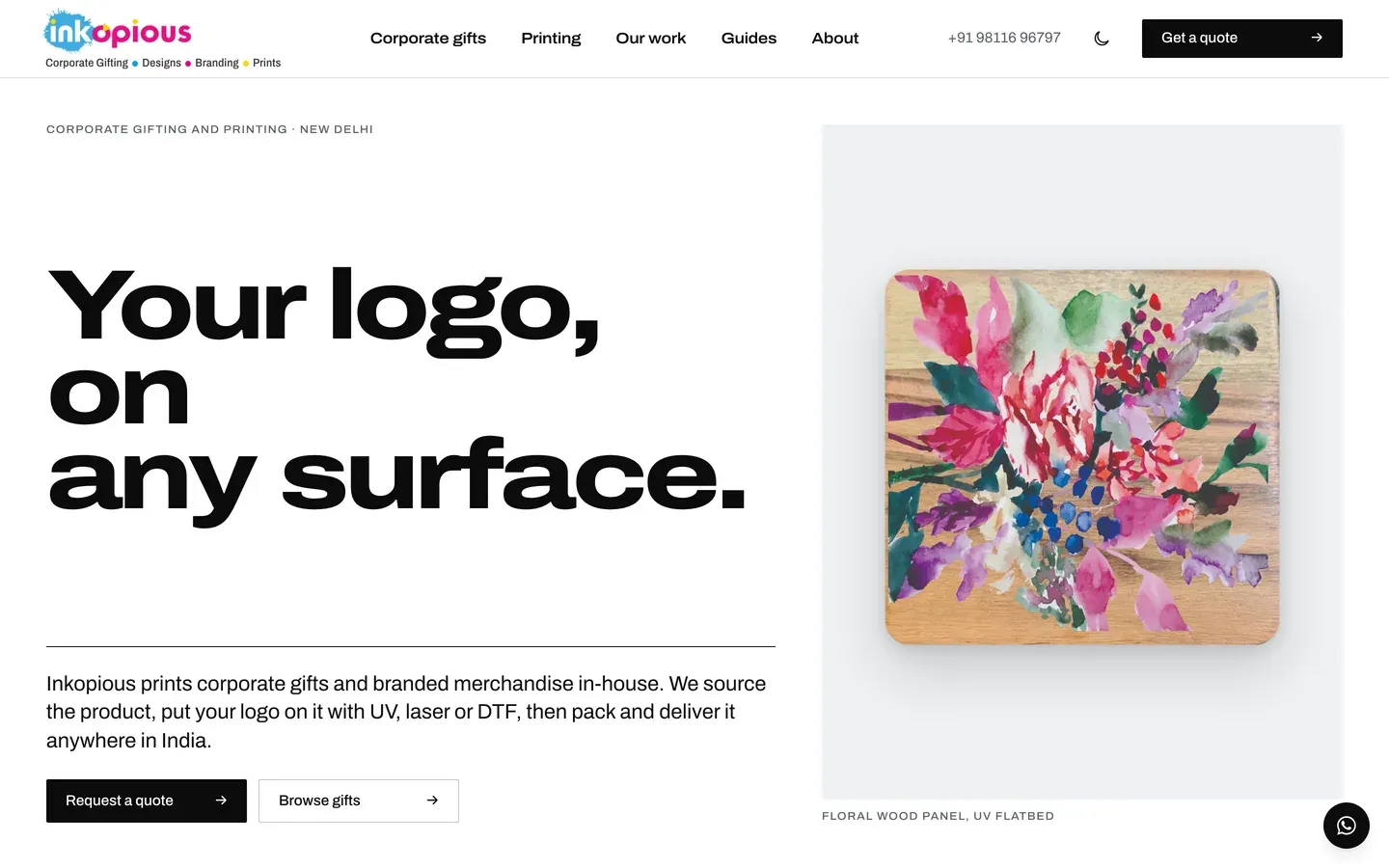
What it had to do
A business whose product is physical, varied and priced per job. Nothing on it can carry a price tag, so the entire site has to earn a quote request instead of a purchase.
What we decided
Corporate gifting is bought by somebody with a budget, a deadline and a headcount, comparing two or three suppliers. They are not buying an item, they are buying confidence that a hundred branded things will arrive on time and look right.
That makes the gallery the most important part of the site by a distance. Work that has actually been produced, photographed properly, is the only thing that answers the question the buyer is really asking.
The rest is built to shorten the path to a conversation. A quote request is the single call to action, and WhatsApp sits available throughout because that is how this trade actually negotiates. What changed in the rebuild is that the buyer no longer has to describe what they want: they collect it as they browse, and the form arrives knowing.
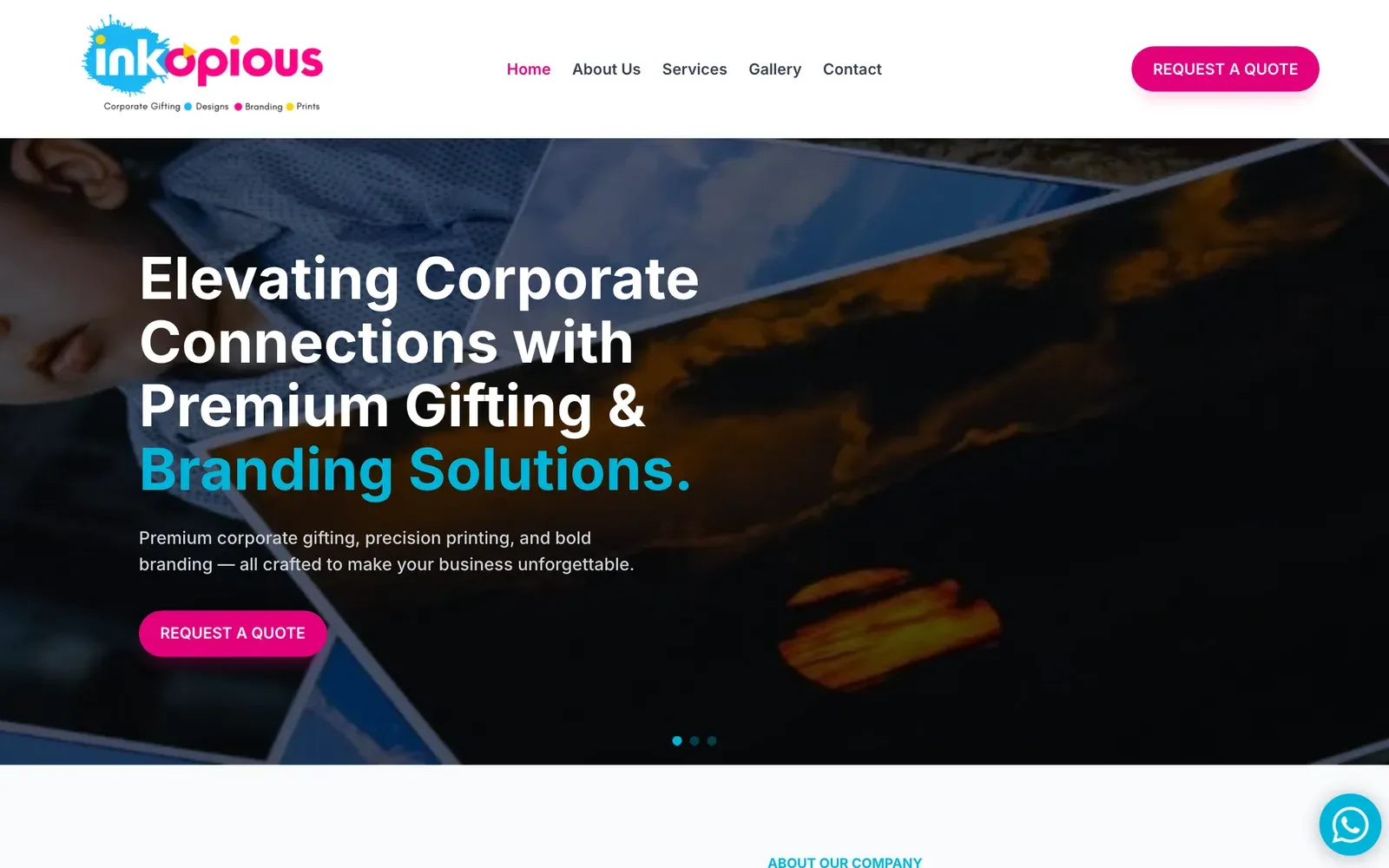
What came off the page matters as much. The old site carried testimonials from people who do not exist, a headline promising mobile apps, and a gallery of mock-ups rather than work. Two different addresses sat on it, which is the kind of detail a careful buyer notices. All of it is gone, and what replaced it came from the client.
What is on the site
Build a list, then ask for one price
Twenty-nine products, filtered by occasion or by who is receiving them. Anything can be added to a running list, and the quote form arrives already knowing what is on it and in what quantity. The buyer stops writing out what they want in an email.
A gallery of produced work
Twenty-four real jobs. The only real answer to "will a hundred of these look right", which is the buyer's actual question.
WhatsApp throughout
Present on every screen. This trade negotiates by message, not by contact form.
Readable in daylight or at night
It follows whatever the visitor's device is set to, with a switch for anyone who wants the other one.
Asks before it counts you, where the law asks that
Visitors in Europe and the UK are asked first, and nothing is measured until they agree. Everyone else gets a plain notice and a switch on the privacy page that turns it off for good.
Written so an assistant can read it out
The services, the catalogue and the questions people ask are all plain text on the page rather than something a machine has to run to see, and there is a plain-language summary of the business for the assistants that look for one.
Every old address still works
The old pages, the old image files and six old portfolio URLs all still arrive where they did, so nothing anybody has linked to over the years breaks.
Before and after
| Before | After | |
|---|---|---|
| Page weight before a single image | 333 KB | 111 KB |
| Things the browser must fetch | 74 | 29 |
| Separate scripts | 33 | 6 |
| Separate stylesheets | 15 | 1 |
| Largest thing on screen appears | 1.25s | 0.62s |
| Everything finished loading | 1.58s | 1.01s |
Measured 22 October 2026. Both measured the same way, on the same emulated phone, five runs each, median reported. The old site was still running on its own hosting as a rollback when these were taken, so it is timed on its own ground rather than on a copy of it. That matters: a single cold run of it put the load at 3.3s, and five runs put it at 1.6s, so the easy comparison would have been twice as flattering as the fair one.
How it performs
- 780 msto paint the main content, on an emulated mid-range phone
- 216 msto first byte
- 1180 KBtransferred, across 28 requests
Measured 2026-10-24. Median of 3 loads, emulated mid-range phone at 390px, cold cache, waiting for the load event. For context, the median across the 300 Chicago-area small business sites we tested was 1,406 ms, and Google treats anything under 2,500 ms as good. This site is about 1.8× quicker than the local median.
Re-measured rather than remembered, which is why the date is on it.
Where it stands in search
First result for its own name. The rebuilt site went live on 22 October 2026, so anything after that is too early to read and we would rather say so.
Checked 22 October 2026. Go and run the search yourself — that is the point of putting it here. What we do not publish is the client's own traffic: those numbers are theirs, not ours to hand around.
Worth taking from this
When nothing can carry a price, every part of the site is working to earn a conversation. That is a different brief from selling, and it needs a different page.
Every site, not just this one
What this client got without asking
Every site we build now gets all of this, whichever plan it is on. Most of it is invisible until it is missing.
- Works on whatever they are holding Checked on a phone, a tablet and a desktop, down to the narrow screen of a folding phone. Not shrunk to fit: laid out so it reads properly at each size.
- Readable by the AI assistants people now ask More people start with ChatGPT or a search assistant than with a search box. The words on the page are plain text an assistant can read and quote, rather than something it has to run to see, and the site tells them it is welcome.
- Built to recognised accessibility guidelines We follow WCAG 2.2 AA, the standard most of the world writes into law. That means it works by keyboard, the text can be enlarged without the layout breaking, colours stay readable, and photographs are described for anyone who cannot see them. We follow the guidelines and test against them; we do not sell a certificate, because nobody can honestly certify this.
- Looks right in daylight and at night Where it suits the brand, the site follows the light or dark setting on the visitor's own device, and offers a switch for anyone who prefers the other one.
- Fast on a bad signal The pages are small and there is very little for the phone to do before it can show them, which is what matters in a van or a car park rather than on office wifi.
- Looks right when somebody shares it Paste a link into WhatsApp, LinkedIn or a text and a proper card appears with the right title and picture, rather than a bare address.